
 EN
EN
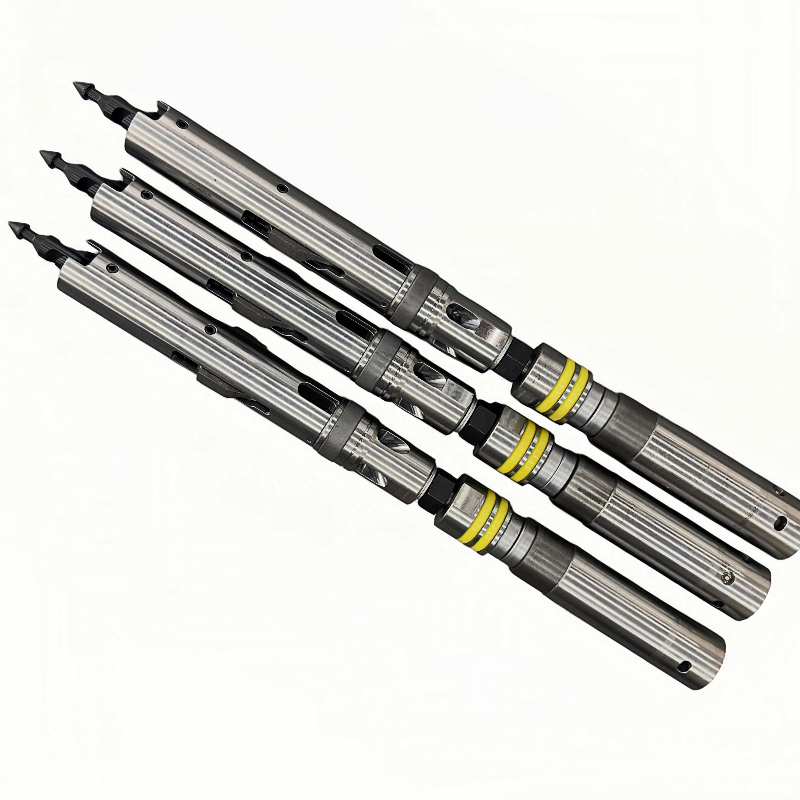
Selecting the Right Drilling Tools for Hard Rock Formations
Diamond vs. Carbide-Tipped Drilling Tools: Matching Tool Design to Rock Abrasivity and UCS
The efficiency of rock drilling hinges on aligning tool composition with geological properties. Diamond drill bits excel in high-abrasivity formations like quartz-rich granite, where their Vickers hardness of 10,000 HV significantly outperforms carbide alternatives (typically 1,200–1,800 HV). This extreme durability reduces replacement frequency by 40% in sustained operations through highly abrasive strata. However, in formations with moderate abrasivity but extreme UCS (Unconfined Compressive Strength) values exceeding 250 MPa, carbide-tipped tools demonstrate superior impact resistance—critical where fracture toughness outweighs wear resistance. The optimal selection matrix reveals:
| Rock Characteristic | Recommended Tool | Key Advantage |
|---|---|---|
| High abrasivity (>5 CERCHAR Index) | Diamond-embedded | Wear resistance |
| Medium abrasivity, UCS > 250 MPa | Tungsten carbide | Fracture toughness |
| Variable formations | Hybrid matrix | Adaptability |
Thermal management remains critical: diamond segments maintain integrity up to 750°C but require continuous water cooling at a minimum flow rate of 15 GPM to prevent graphitization. Field studies in Canadian Shield operations confirm carbide’s economic advantage where UCS dominates abrasivity concerns—yielding 30% lower cost-per-meter in diorite formations compared to diamond alternatives.
PDC vs. Surface-Set Diamond Bits in Massive Granite: When Tool Geometry and Thermal Stability Dictate Performance
Massive granite formations introduce unique challenges where bit geometry directly influences penetration rates and thermal resilience. PDC (Polycrystalline Diamond Compact) bits—with their continuous cutting edge—achieve 35% faster ROP (Rate of Penetration) in homogeneous granite due to superior chip evacuation and consistent contact pressure. Yet their laminated structure is vulnerable to thermal cycling in stop-start operations: prolonged exposure beyond 650°C causes delamination in 78% of field cases. Surface-set bits, featuring individual diamond grits embedded in a steel matrix, offer 50% greater thermal stability and are preferred for projects requiring frequent bit extraction or intermittent drilling.
Operational parameters reflect this trade-off:
- PDC bits perform optimally at 150–200 RPM and 40–60 kN WOB (Weight on Bit) for sustained cutting.
- Surface-set bits require higher rotational speeds (250–300 RPM) at reduced WOB (20–40 kN) to minimize diamond pullout while preserving matrix integrity.
Coolant channel design is equally decisive—cross-drilled nozzles must sustain fluid velocity >3 m/sec directly behind cutting faces to suppress localized heating. A 2023 comparative study in Norwegian quarries found PDC bits averaged 6.2 m/hr versus surface-set’s 4.5 m/hr in consistent granite—but required three times more replacements during interrupted cycles, underscoring the importance of matching bit type to operational continuity.
Optimizing Drilling Parameters to Maximize Drilling Tools Efficiency
Balancing RPM, Weight-on-Bit, and Torque to Prevent Bit Glazing and Core Locking
Precise calibration of rotational speed (RPM), weight-on-bit (WOB), and torque is essential to preserve tool integrity and core recovery in hard rock. Excessive RPM without adequate WOB causes diamond segments to overheat and glaze—reducing cutting efficiency by up to 60% in granite. Conversely, insufficient rotation under high axial loads risks core jamming, barrel distortion, and premature bit failure. For massive quartzite (UCS >200 MPa), field-proven optimal parameters are:
- 400–600 RPM with 800–1,200 kg WOB
- Torque maintained below 3,500 Nm to avoid matrix fatigue and micro-cracking
Real-time monitoring via embedded sensors enables dynamic adjustment—preventing thermal runaway while sustaining target penetration rates and minimizing unproductive time.
Rotary vs. Percussive Energy Transfer: Selecting the Optimal Drive System for High-Strength Formations
Drive system selection depends on rock compressive strength, fracture density, and core quality requirements. Rotary systems deliver consistent torque ideal for homogeneous igneous formations (e.g., basalt), achieving up to 92% core recovery and stable ROP. Percussive mechanisms—particularly those operating above 1,800 BPM—excel in fractured metamorphic rock, inducing tensile failure that shatters high-UCS materials more efficiently than rotary shear alone. However, percussive drilling demands ≥15 m³/min air volume to evacuate cuttings and prevent bit balling—a key constraint in deep or confined boreholes. For transitional zones—such as alternating limestone and chert bands—hybrid rotary-percussion systems provide the best balance: maintaining penetration speed while preserving core integrity and reducing risk of catastrophic tool failure.
Extending Drilling Tools Life Through Thermal and Mechanical Protection
Water Cooling Best Practices: Flow Rate, Nozzle Placement, and Mitigating Thermal Shock on Diamond Segments
Effective thermal management is foundational to extending tool life in hard rock drilling. Coolant flow must be calibrated to remove cuttings efficiently and dissipate heat—typically 10–15 L/min per inch of bit diameter strikes the optimal balance between hydraulic efficiency and cooling capacity. Nozzle placement is equally vital: directed flow toward diamond segments and the rock-tool interface reduces localized thermal stress concentrations by up to 35%. Consistent coolant temperature prevents thermal shock—a leading cause of micro-fractures in diamond matrices when temperature differentials exceed 200°C. Gradual ramp-up of coolant flow during startup avoids sudden quenching of heated segments. Operators adhering to these protocols reduce segment cracking by over 40% while sustaining penetration rates in granite and quartzite.
Integrating Geological Data to Inform Drilling Tools and Technique Selection
Effective core drilling in hard rock hinges on precise geological integration. Formation characteristics—including fracture density, mineral composition, and abrasivity—directly dictate both tool selection and operational parameters. For example, highly fractured quartzite requires lower RPM to prevent core disintegration, while massive granite favors surface-set diamond bits for thermal stability during intermittent operations. Analysis of historic drill logs and real-time sensor data (e.g., penetration rate anomalies, vibration signatures, and torque spikes) enables adaptive refinement—reducing bit wear by up to 30% and preventing catastrophic failures in lithologically variable sequences. By anchoring decisions in geological insight—not just equipment availability—operators achieve a sustainable balance between drilling efficiency, core quality, and tool longevity across the most challenging formations.
FAQ
What is the difference between diamond and carbide-tipped drilling tools?
Diamond tools excel in highly abrasive formations due to their extreme wear resistance and hardness, while carbide-tipped tools are better suited for formations with high Unconfined Compressive Strength (UCS) where impact resistance is critical.
How can thermal management affect the performance of drilling tools?
Proper thermal management using water cooling mitigates overheating, maintains tool integrity, and prevents thermal shock, particularly in diamond tools, which are susceptible to damage at high temperatures.
What type of drilling tool is most effective for granite formations?
PDC bits perform better in homogeneous granite for faster penetration rates, while surface-set diamond bits provide superior thermal stability for intermittent drilling operations.
How do rotational speed (RPM) and weight-on-bit (WOB) affect drilling efficiency?
Appropriate RPM and WOB settings prevent issues such as bit glazing, core jamming, and matrix fatigue, ensuring optimal performance and tool longevity in hard rock formations.